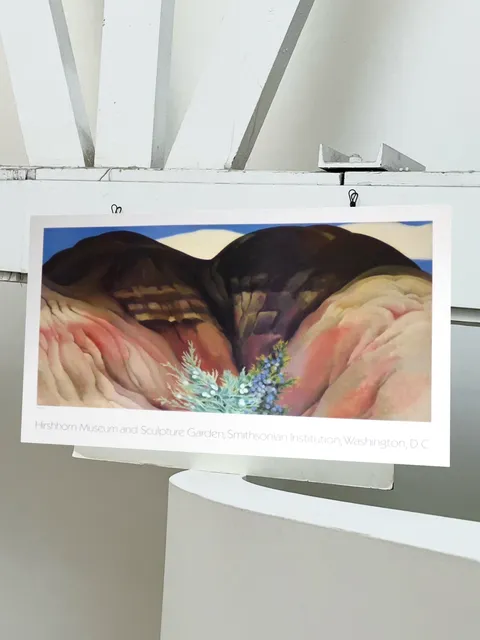
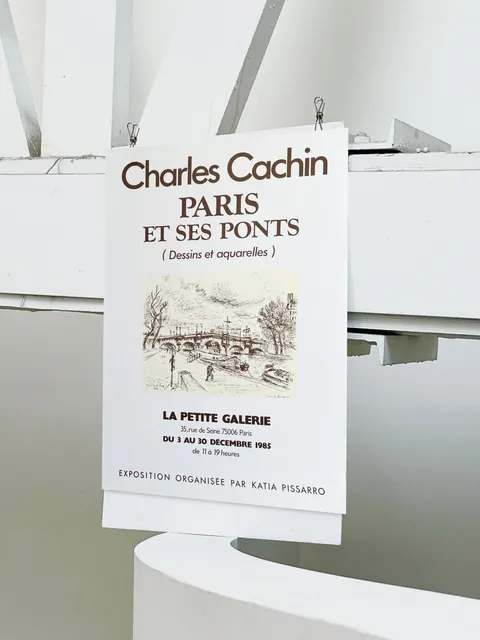
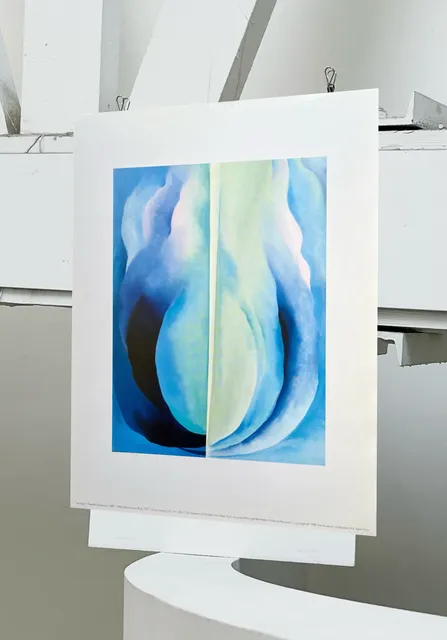
 1988 Georgia O'Keeffe 'Abstraction Blue' German Art Print
1988 Georgia O'Keeffe 'White Trumpet Flower' German Art Print
$129.95
Form
View listing ↗Los Angeles, CA · Reported available
- Designer
- Artist
- Named in listing
1988
- Type
Prints
- Period
1988
- Dimensions
Height 15.5 in × Width 12.4 in
- Materials
German Art Print
- Condition
View full details
Excellent condition. About the Artist - Georgia O'Keeffe Georgia O'Keeffe was born November 15, 1887, on a farm in Sun Prairie, Wisconsin, and went on to become known as the "Mother of American modernism," celebrated internationally for her paintings of natural forms, particularly flowers, hills, and desert-inspired landscapes drawn from the places she lived. She trained in traditional realism at the Art Institute of Chicago and the Art Students League, even winning a still-life prize for a painting of a dead rabbit and copper pot, but grew disillusioned and quit painting for a time. She was reignited by the abstract, design-based teachings of Arthur Wesley Dow, which set her on the path toward the bold, semi-abstract style she became famous for. The defining relationship of her life was with photographer Alfred Stieglitz, who first exhibited her work in 1916 and became her lover, notably while he was 23 years her senior and still married to someone else. She also posed nude for an extensive series of his photographs, and the two eventually married. As her large flower paintings gained fame, critics widely read them as overt sexual symbolism, an interpretation O'Keeffe found ludicrous; she insisted the paintings were instead a deliberate response to skyscrapers, meant to redirect attention back to beauty people were overlooking. She chose not to publicly fight the sexualized reading, which arguably let it become the dominant lens through which her work is still viewed today. After Stieglitz's death in 1946, O'Keeffe moved permanently to New Mexico, living between Ghost Ranch in Abiquiú and later Santa Fe for the next 40 years, painting the bones, bleached skulls, and landscapes she's now equally famous for. Her circle there included the Lindberghs, Joni Mitchell, Allen Ginsberg, and Ansel Adams, and she maintained a notable friendship with Frida Kahlo. Late in life, after losing much of her eyesight, she formed a controversial relationship with ceramicist Juan Hamilton, a "notorious" pairing given their roughly six-decade age gap. Hamilton went on to inherit the bulk of her estate, sparking a public legal battle after her death. One biographer also notes she grew "callous" toward old friends in her final, nearly blind years. She died in Santa Fe in 1986 at age 98, and in 2014 her painting Jimson Weed/White Flower No. 1 sold for $44,405,000, at the time the highest price ever paid for a work by a female artist.
Condition: Excellent condition.
Additional details
- Artwork title
White Trumpet Flower
- National description
German
- Design / publication date
This artwork depicts 'White Trumpet Flower' originally painted in 1932.
Dealer notes
1988 Georgia O'Keeffe 'White Trumpet Flower' German Art Print. Printed in West Germany for Neues Publishing Company in 1998. Produced as part of a limited release of six prints from the artist. Featuring her art sourced from a variety of major US based museums. Shop our other collection of prints to present works as a series or create a unique gallery wall etc. This artwork depicts 'White Trumpet Flower' originally painted in 1932. Size: 15.5”H x 12.4”W. About the Artist - Georgia O'Keeffe Georgia O'Keeffe was born November 15, 1887, on a farm in Sun Prairie, Wisconsin, and went on to become known as the "Mother of American modernism," celebrated internationally for her paintings of natural forms, particularly flowers, hills, and desert-inspired landscapes drawn from the places she lived. She trained in traditional realism at the Art Institute of Chicago and the Art Students League, even winning a still-life prize for a painting of a dead rabbit and copper pot, but grew disillusioned and quit painting for a time. She was reignited by the abstract, design-based teachings of Arthur Wesley Dow, which set her on the path toward the bold, semi-abstract style she became famous for. The defining relationship of her life was with photographer Alfred Stieglitz, who first exhibited her work in 1916 and became her lover, notably while he was 23 years her senior and still married to someone else. She also posed nude for an extensive series of his photographs, and the two eventually married. As her large flower paintings gained fame, critics widely read them as overt sexual symbolism, an interpretation O'Keeffe found ludicrous; she insisted the paintings were instead a deliberate response to skyscrapers, meant to redirect attention back to beauty people were overlooking. She chose not to publicly fight the sexualized reading, which arguably let it become the dominant lens through which her work is still viewed today. After Stieglitz's death in 1946, O'Keeffe moved permanently to New Mexico, living between Ghost Ranch in Abiquiú and later Santa Fe for the next 40 years, painting the bones, bleached skulls, and landscapes she's now equally famous for. Her circle there included the Lindberghs, Joni Mitchell, Allen Ginsberg, and Ansel Adams, and she maintained a notable friendship with Frida Kahlo. Late in life, after losing much of her eyesight, she formed a controversial relationship with ceramicist Juan Hamilton, a "notorious" pairing given their roughly six-decade age gap. Hamilton went on to inherit the bulk of her estate, sparking a public legal battle after her death. One biographer also notes she grew "callous" toward old friends in her final, nearly blind years. She died in Santa Fe in 1986 at age 98, and in 2014 her painting Jimson Weed/White Flower No. 1 sold for $44,405,000, at the time the highest price ever paid for a work by a female artist.
Listing information
Last checked
Added
Details are supplied by the dealer. Confirm availability and shipping before purchasing.
Loading history…