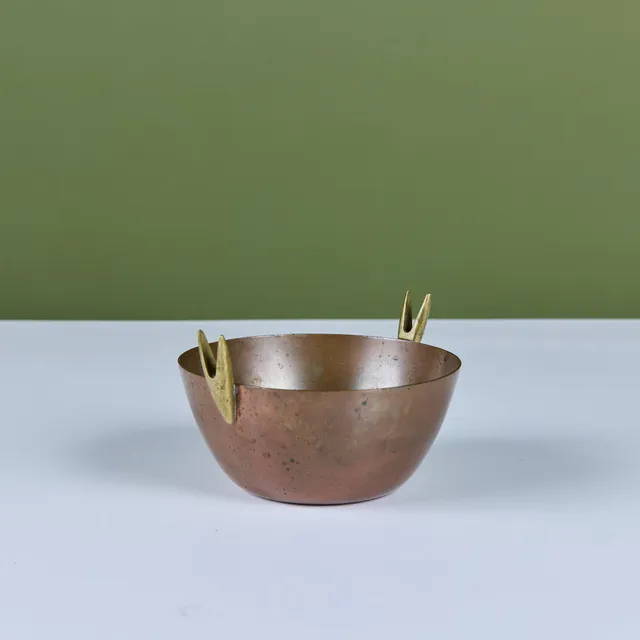
 Carl Auböck Copper and Brass Bowl for Illums Bolighus
1 / 20
Large Burmes Brass, Copper, Silver Inlaid Ceremonial Bowl with Avatars of Vishnu
$1,665
- Type
Bowls
- Period
Early 20th Century Style: Folk Art
- Origin
- Dimensions
Height 8.5 in × Diameter 9.5 in
- Materials
Dealer notes
Large Asian Burmese brass ceremonial bowl with silver and copper inlaid with the ten Hindu Avatars of Vishnu. Fine example of Tanjore work, this brass bowl that has been overlaid with alternating copper and silver chased plaques, with high quality in detail executed in mixed metal repoussé with contrasting patination, showing Hindu deities. The base is engraved with a lotus flower motif. (This type of work is known as Tanjore work, after the south Indian city where much of this work was executed.) The depictions on the main plaques are believed to relate to those seen carved in relief on rock on the façade off the Great Temple (Brihadisvara) in Tanjore. A southern Indian magnificent silver and copper inlaid vase, 19th century Tapered and chased body made of copper inlaid with beaded bands and with the ten avatars of Vishnu: 1. Matsya (the fish) 2. Koorma (the tortoise) 3. Varaha (the boar) 4. Narasimha (the human-lion – shown on this bowl as a lion-man figure about to devour a human victim.) 5. Vamana (the dwarf) 6. Parasurama (the angry man – presented on this bowl as a figure with an axe, a bow and an arrow.) 7. Rama (the perfect man, king of Ayodha) 8. Krishna (the divine statesman – shown here as Krishna on a cobra throne.) 9. Balarama (elder brother of Krishna) 10. Kalki (the warrior.) Kalki (the warrior), the last avatar, is yet to appear and so somewhat poetically is represented on this bowl has a horse saddled up and with an umbrella overhead but with no rider. Tanjore (Thanjavur), South India late 19th century. Signed by the maker. Dimensions: Height 8.5 in, Diameter 9.5 in Origin: India Period: Early 20th Century Style: Folk Art Materials: Brass, Copper, Silver
Listing information
Last checked
Added
Details are supplied by the dealer. Confirm availability and shipping before purchasing.
Loading history…