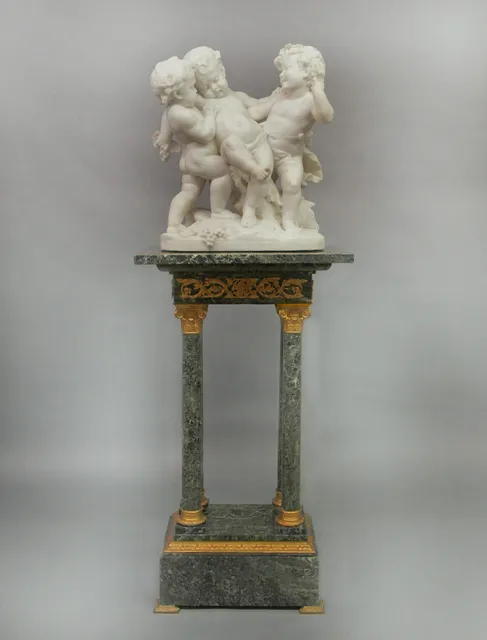
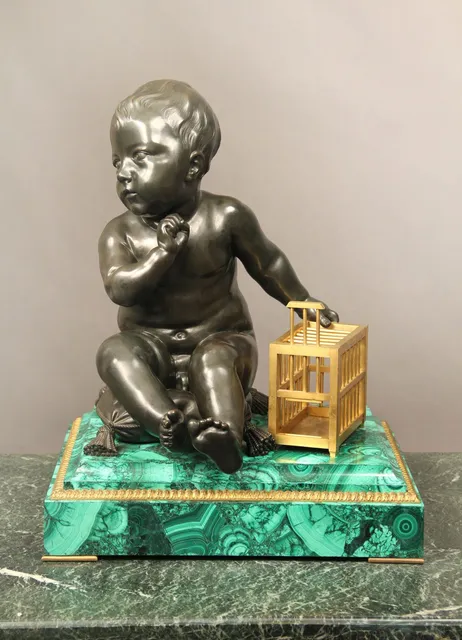
 A Fine Late 19th Century Gilt and Patinated Bronze Sculpture Entitled “Enfant à la Cage” On A Malachite Veneered Marble Base by Thiebaut Freres
A Large and Exceptional Late 19th Century Patinated Bronze Figural Group Entitled “Quand Meme” by Mercié and Barbedienne
$65,000
Charles Cheriff Galleries
View listing ↗Long Island City, NY · Reported available
- Maker
- Artist
- Named in listing
Mercié and Barbedienne
- Period
Late 19th Century
- Dimensions
Width 127 cm × Depth 69 cm
- Materials
cast in bronze in four sizes by Ferdinand Barbedienne
Patinated Bronze
- Finish
Patinated
Additional details
- Artwork title
Quand Meme
Dealer notes
$65,000 Marius-Jean-Antonin Mercié and Ferdinand Barbedienne Intended to pay tribute to the resistance of the city of Belfort during the Franco-Prussian War of 1870, the group features two characters, a wounded soldier and a woman in Alsatian costume who personalize the city of Belfort, the Republic and to France. While the wounded soldier is about to succumb, the woman takes her Chassepot rifle from him and gazing deliberately towards the horizon seems to defy the enemy Signed A. Mercie to the front plaque and F. Barbedienne Fondeur Paris to the base. After the success of his celebrated bronze group Gloria Victis at the Salon of 1874, Mercié’s best known work was the present allegorical group Quand Même, which was erected in 1884 on the place d’ Armes in Belfort, in commemoration of the courage of the citizens of the town during the Prussian invasion of 1870. The original full-size plaster model was exhibited at the Salon in 1884 and due to its tremendous popularity, was subsequently cast in bronze in four sizes by Ferdinand Barbedienne. Ferdinand Barbedienne (1810-1892) was a highly important and prolific bronze founder of one of the most important French art foundries. He pioneered the use of mounts and, more commonly, bronze sculpture including figures and animals. Barbedienne produced catalogues of bronze reproductions of Greek and Roman classical sculpture and experimented with ‘champleve’ and ‘cloisonné’ enamels during the third quarter of the century. Barbedienne exhibited several pieces of furniture at the 1855 Paris Exhibition including a gilt-bronze mounted oak dressing table and a gilt-bronze mounted ebony veneered bookcase. Both pieces were executed in his favoured Renaissance revival style for furniture. Furniture with mounts signed by Barbedienne is extremely rare. The Barbedienne foundry employed up to three hundred skilled labourers, handling the casting of numerous national monuments and architectural schemes. Ferdinand Barbedienne himself also took an active part in the promotion of contemporary sculpture and became one of the founders for Davis d’Angers’ medallions as well as much of Rude’s sculpture. His signature varied from hand written capitals to stamp in capitals, usually ‘F. Barbedienne, Fondeur’ or ‘BARBEDIENNE PARIS’. In 1839 Barbedienne collaborated with the inventor Achille Collas who had succeeded in enlarging and reducing works of art to arbitrary sizes by a simple mathematical calculation, allowing the accurate reduction of classical and contemporary marbles for the purpose of reproduction in bronze. In 1850 Barbedienne was commissioned to furnish the Paris town hall for which he was awarded with the ‘medaille d’ honneur’ at the Paris World Exhibition in 1855. Sculpture Height – 50 inches / 127cm Width – 27 inches / 69cm Depth – 22 inches / 56cm Pedestal Height – 34 inches / 86cm
Listing information
Last checked
Added
Details are supplied by the dealer. Confirm availability and shipping before purchasing.
Loading history…