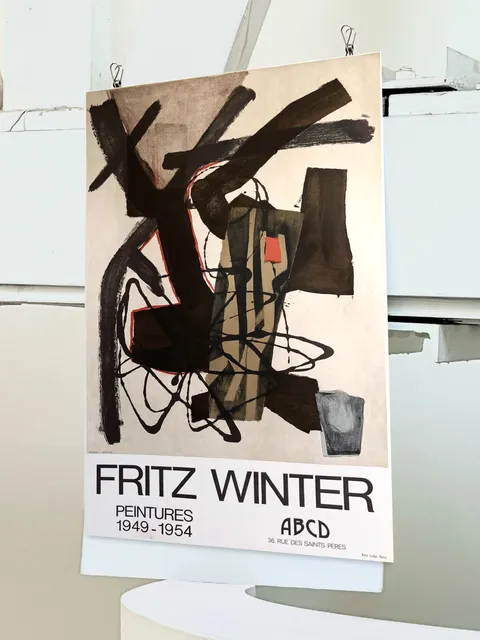
 1970s Fritz Winter French Art Exhibition Lithograph
1950s Alfred Manessier French Art Exhibition Lithograph
$249.95
Form
View listing ↗Los Angeles, CA · Reported available
- Artist
- Type
Prints
- Period
1950s
- Measurements (dealer text)
12ʺW × 19.4ʺH.
Size: 12ʺW × 19.4ʺH.
- Materials
thick matte paper
- Condition
View full details
Excellent condition. About the Artist - Alfred Manessier Alfred Manessier was born on December 5, 1911, in Saint-Ouen, a small village in the Somme region of northern France. His mother's family ran a café, and he spent childhood summers on the coast at Le Crotoy, where the changing light over the bay of the Somme left an impression that would echo through his work for decades. He moved to Paris in 1929 to study architecture at the École des Beaux-Arts, but was soon drawn to painting, teaching himself by copying Rembrandt, Tintoretto and other old masters at the Louvre. He later studied at the Académie Ranson under Roger Bissière, whose influence steered him away from academic realism and toward a freer, more expressive use of color and form. The turning point of Manessier's life came in 1943, when he spent a few days at La Grande Trappe, a Trappist monastery in Normandy, and experienced a profound religious conversion. From then on, his art became a search for a way to express the spiritual without literal depiction. He became one of the leading figures of the "New School of Paris" and of lyrical abstraction, famous for glowing, stained-glass-like canvases built from interlocking bands of rich color. In 1941, during the Nazi occupation, he had already taken part in the defiant exhibition "Young Painters of the French Tradition," which showed modern, brightly colored work under the noses of occupiers who condemned such art as "degenerate." Manessier was also a pioneer of modern stained glass. In 1948, his windows for the small church of Les Bréseux in eastern France were among the first abstract stained glass windows installed in a historic church, a controversial choice at the time that helped open the door to modern art in sacred spaces. He went on to design windows for churches and cathedrals across France, Switzerland and Germany, including a major cycle for the Cathedral of St. Nicholas in Fribourg. International recognition followed, most notably the Grand Prize for painting at the 1962 Venice Biennale. He also used abstraction to respond to current events, with works honoring Martin Luther King Jr. and mourning the crushing of the 1956 Hungarian uprising. Manessier died in 1993 after a car accident near Orléans, still working at the age of 81.
Condition: Excellent condition.
- Style
French Art Exhibition
- Medium
Offset lithograph
Additional details
- National description
French
Dealer notes
1950s Alfred Manessier French Art Exhibition Lithograph. Offset lithograph printed in France on thick matte paper. Promoting an art exhibition event of the artist's works held at Musee National D'Art Moderne, Paris, France in 1950. With the design featuring a bold red and blue abstract image of his 1950 original painting. Titled ' La Couronne D'Epines' otherwise known as The Crown of Thorns'. Note - Lithograph comes with text about the artwork on reverse side. About the Artist - Alfred Manessier Alfred Manessier was born on December 5, 1911, in Saint-Ouen, a small village in the Somme region of northern France. His mother's family ran a café, and he spent childhood summers on the coast at Le Crotoy, where the changing light over the bay of the Somme left an impression that would echo through his work for decades. He moved to Paris in 1929 to study architecture at the École des Beaux-Arts, but was soon drawn to painting, teaching himself by copying Rembrandt, Tintoretto and other old masters at the Louvre. He later studied at the Académie Ranson under Roger Bissière, whose influence steered him away from academic realism and toward a freer, more expressive use of color and form. The turning point of Manessier's life came in 1943, when he spent a few days at La Grande Trappe, a Trappist monastery in Normandy, and experienced a profound religious conversion. From then on, his art became a search for a way to express the spiritual without literal depiction. He became one of the leading figures of the "New School of Paris" and of lyrical abstraction, famous for glowing, stained-glass-like canvases built from interlocking bands of rich color. In 1941, during the Nazi occupation, he had already taken part in the defiant exhibition "Young Painters of the French Tradition," which showed modern, brightly colored work under the noses of occupiers who condemned such art as "degenerate." Manessier was also a pioneer of modern stained glass. In 1948, his windows for the small church of Les Bréseux in eastern France were among the first abstract stained glass windows installed in a historic church, a controversial choice at the time that helped open the door to modern art in sacred spaces. He went on to design windows for churches and cathedrals across France, Switzerland and Germany, including a major cycle for the Cathedral of St. Nicholas in Fribourg. International recognition followed, most notably the Grand Prize for painting at the 1962 Venice Biennale. He also used abstraction to respond to current events, with works honoring Martin Luther King Jr. and mourning the crushing of the 1956 Hungarian uprising. Manessier died in 1993 after a car accident near Orléans, still working at the age of 81.
Listing information
Last checked
Added
Details are supplied by the dealer. Confirm availability and shipping before purchasing.
Loading history…