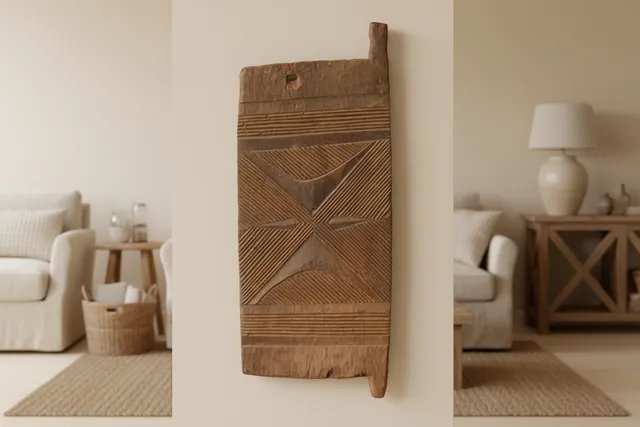
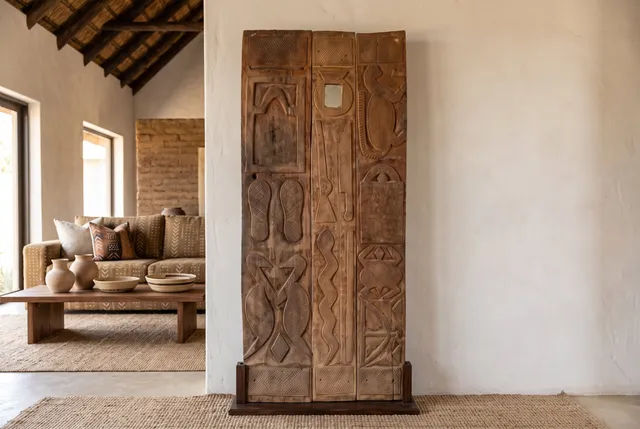
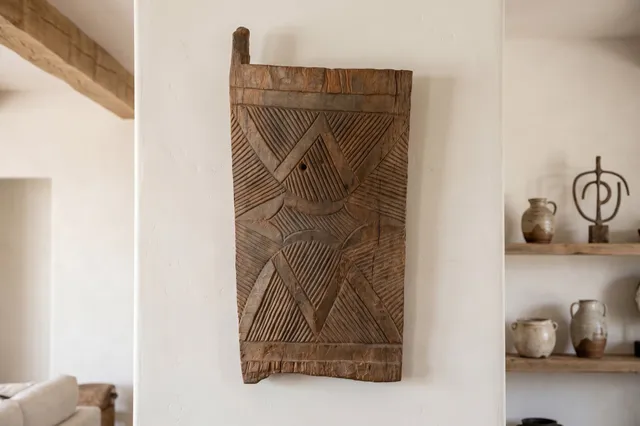
 Antique African Radiating Sunburst Carved Door
1 / 9
Antique Farmhouse African Two Plank Carved Door
$3,845
DE-COR
View listing ↗Pasadena, CA · Reported available
- Dimensions
Width 24 in × Depth 1.5 in × Height 60 in × Width 26 in × Depth 12 in × Height 62 in
- Condition
View full details
Moderate antique wear, one full-thickness crack near the upper right edge, minor associated surface loss, wire-stitched seam repair (construction, not damage), sliding lock bar intact and functional; structurally stable Q: How was this Dogon door attached and secured to the granary structure? A: It utilized an integrated wooden pivot pin system rather than metal hinges. The door features hand-carved vertical wooden hinge posts pegged to the upright with square timber pins, allowing the entire door to rotate in stone or earthen sockets built into the mud-brick granary facade. Hand-forged iron staples and a lower wooden cross cleat bound the two planks together against physical strain.
- Attribution
Attributed to the late 19th to early 20th century (circa 1890s–1920s), this authentic two-plank granary door originates from the cliffside compounds of the Bandiagara Escarpment in Mali (Dogon culture)
Dealer notes
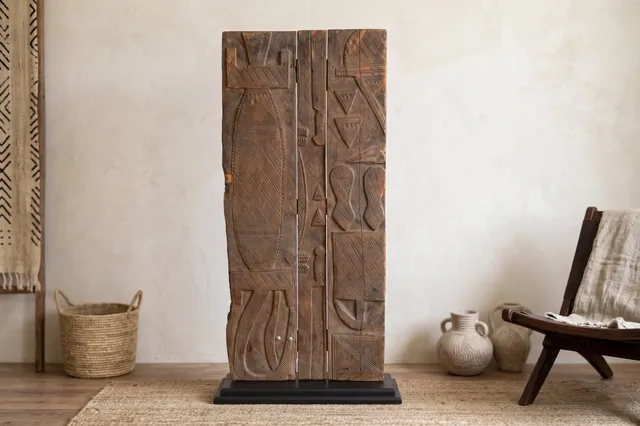
Attributed to the late 19th to early 20th century (circa 1890s–1920s), this authentic two-plank granary door originates from the cliffside compounds of the Bandiagara Escarpment in Mali (Dogon culture). Carved from dense indigenous African hardwood, the face presents a minimalist geometric program of triple-grooved converging chevrons and cosmic "X" diagonals—sacred symbols invoking life-giving water pathways and fertile agricultural furrows. The two vertical planks are joined along the center seam by original hand-forged blacksmith iron staples. Outstanding structural features include intact vertical wooden pivot hinge posts secured with hand-cut square timber pegs at both the upper finial and lower base, alongside an original horizontal wooden cross-bar cleat spanning the lower register. The timber displays a dry, sun-cured honey-amber patina on the carved face with rich adze-cut gouge marks, contrasting with a smoke-darkened reverse. Stably presented on a custom tiered black steel display base, its 60-inch panel height (62 inches overall mounted) makes it a museum-caliber architectural focal point. *Origin: Dogon or Bamana tradition, Mali, West Africa *Era: Early 20th century *Material: Hand-carved hardwood, iron wire seam repair, wood lock hardware *Finish: Natural weathered patina, unsealed *Dimensions: Door 24"W x 1.5"D x 60"H; on included stand 26"W x 12"D x 62"H *Condition: Moderate antique wear, one full-thickness crack near the upper right edge, minor associated surface loss, wire-stitched seam repair (construction, not damage), sliding lock bar intact and functional; structurally stable Q: How was this Dogon door attached and secured to the granary structure? A: It utilized an integrated wooden pivot pin system rather than metal hinges. The door features hand-carved vertical wooden hinge posts pegged to the upright with square timber pins, allowing the entire door to rotate in stone or earthen sockets built into the mud-brick granary facade. Hand-forged iron staples and a lower wooden cross cleat bound the two planks together against physical strain.
Listing information
Last checked
Added
Details are supplied by the dealer. Confirm availability and shipping before purchasing.
Loading history…